
The accounting profession is undergoing one of the most significant transformations in its history. For decades, accounting firms primarily focused on compliance tasks such as bookkeeping, tax preparation, payroll, and financial reporting.
While these services remain essential, client expectations, technology advancements, and workforce dynamics are reshaping what accounting firms must offer to stay competitive.
The next generation of accounting firms will look dramatically different from traditional practices. They will be technology-driven, advisory-focused, globally connected, and built for efficiency rather than hours billed.
Firms that adapt early will position themselves as strategic partners for their clients rather than just compliance providers. Let’s explore the defining characteristics of the next generation of accounting firms.
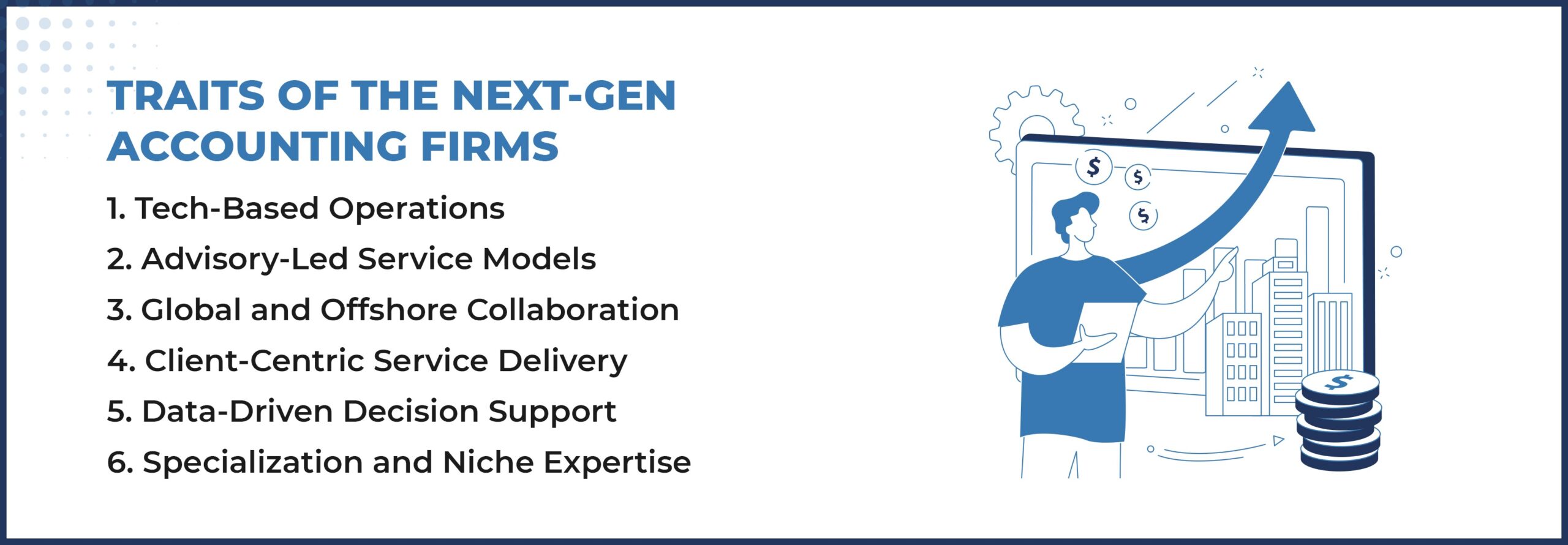
TRAITS OF THE NEXT-GEN ACCOUNTING FIRMS
Tech-Based Operations
Modern accounting firms will operate on integrated, cloud-based technology stacks. Instead of relying on multiple disconnected tools and manual spreadsheets, next-generation firms will adopt unified platforms that automate core processes. AI-powered automation are already transforming tasks such as:
- Transaction categorization
- Bank reconciliations
- Invoice processing
- Payroll management
- Financial reporting
Cloud accounting platforms enable real-time collaboration between accountants and clients. Financial data can be accessed anytime, anywhere, making it easier to provide timely advice rather than retrospective reporting. In the near-future, accounting firms will not simply use technology, but will design service delivery models around it.
Advisory-Led Service Models
One of the most significant changes in the profession is the shift from compliance work to advisory services. As automation reduces the time required for routine accounting tasks, firms are increasingly focusing on helping clients make better financial decisions.
This means providing strategic guidance rather than just preparing reports. Next-generation firms will expand their advisory offerings to include:
- Cash flow planning
- Profitability analysis
- Business growth strategies
- Financial forecasting
- Risk mitigation
Clients today want accountants who understand their business challenges and provide proactive recommendations. Accounting firms that embrace this advisory role will build deeper, longer-lasting client relationships.
Global and Offshore Collaboration
Talent shortages are becoming a growing concern in the accounting profession, particularly in North America and other developed markets. Many firms struggle to hire and retain skilled professionals locally.
The next generation of firms will address this challenge by building global teams and leveraging offshore talent. Offshore accounting professionals can support functions such as:
- Bookkeeping
- Financial statement preparation
- Payroll processing
- Data reconciliation
- Tax preparation support
By combining local advisory expertise with global delivery teams, firms can operate more efficiently and scale their services without increasing overhead costs. This hybrid model enables CPA firms to focus on high-value advisory work while offshore teams handle operational tasks.
Client-Centric Service Delivery
Traditional accounting firms often operate around internal workflows and deadlines. Next-generation firms, however, will design their services around the client experience. Clients increasingly expect:
- Faster response times
- Real-time financial insights
- Digital collaboration tools
- Clear communication and transparency
To meet these expectations, firms will implement client portals, automated reporting dashboards, and regular advisory meetings. Rather than delivering financial reports once a year, accountants will provide ongoing insights throughout the year.
This continuous engagement helps businesses stay financially healthy and make informed decisions. In many ways, accounting firms will begin to function more like financial partners than service providers.
Data-Driven Decision Support
Financial data has always been valuable, but next-generation accounting firms will transform raw data into actionable intelligence. Using advanced analytics tools, firms will analyze patterns in revenue, expenses, and operational performance.
This allows them to identify opportunities for cost optimization, revenue growth, and risk mitigation. For example, accountants will be able to help clients:
- Identify the most profitable products or services
- Detect cash flow bottlenecks before they become problems
- Optimize pricing strategies
- Improve operational efficiency
Specialization and Niche Expertise
Another defining feature of next-generation firms will be specialization. Instead of offering generic services to every type of business, firms will increasingly focus on specific industries or niches. Examples include:
- E-commerce accounting
- SaaS financial management
- Healthcare accounting
- Real estate accounting
Specialization allows firms to develop deep expertise in industry-specific regulations, financial metrics, and operational challenges. Niche expertise enables accounting firms to provide more relevant and impactful guidance.
Wrapping Up
The accounting profession is evolving, slowly but surely. The next generation of accounting firms will be defined by technology, advisory expertise, global collaboration, and client-focused service models.
 Instead of simply preparing financial reports, accountants will help businesses with critical financial decisions, enabling sustainable growth. Firms that embrace innovation and rethink their traditional operating models will thrive in this new environment.
Those that resist change may struggle to remain relevant. So better start today.