Small businesses have always operated in an environment that demands constant adaptation. Regulatory shifts, economic cycles, new technologies, and evolving customer expectations regularly reshape the way businesses operate. Yet the financial landscape approaching 2026 feels different from previous cycles.
Several developments are converging at the same time, such as AI is becoming embedded in accounting systems while sustainability reporting is gradually extending beyond large corporations to their supply chains.
These changes are transforming the financial environment for small and medium-sized businesses and are redefining how they manage finance, handle accounting, and plan for growth. Understanding these developments early can help business owners avoid reactive decision-making later.
The following five financial trends are likely to shape how small businesses manage their finances in 2026 and beyond.
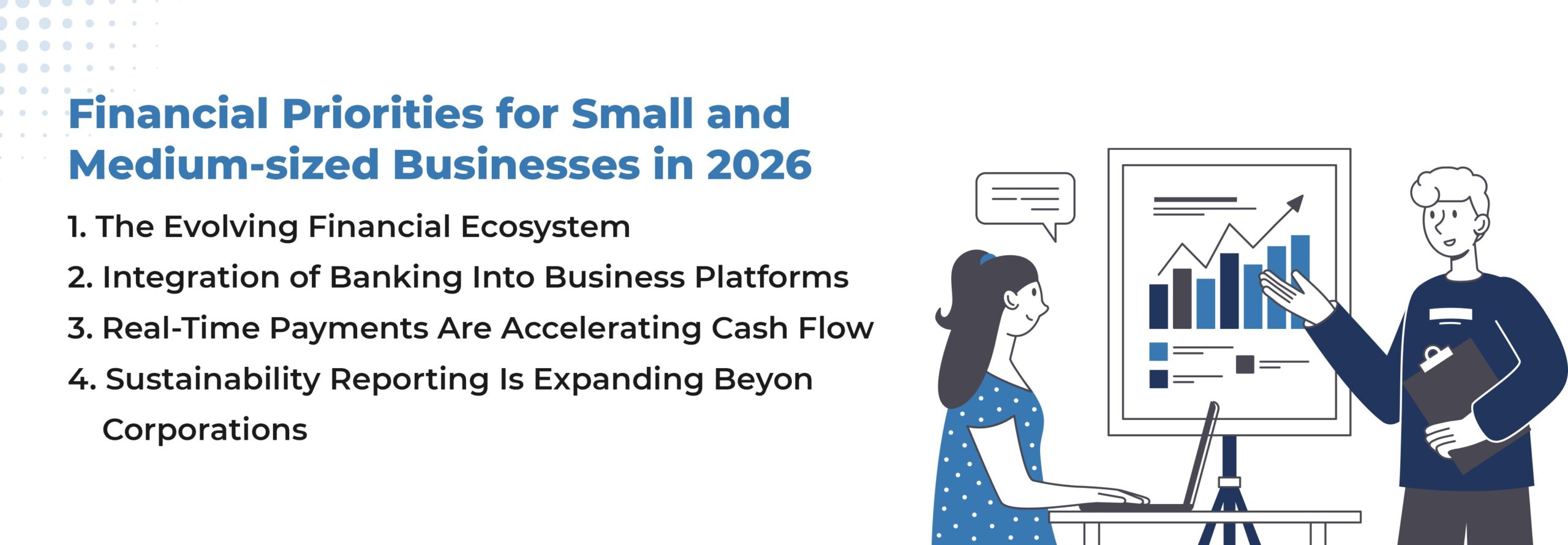
Financial Priorities for Small and Medium-sized Businesses in 2026
1. The Evolving Financial Ecosystem
Over the past few years, FinTech has accelerated innovation aimed at smaller organizations. Advanced financial tools are now becoming accessible to small businesses through affordable subscription-based software. At the same time, companies across industries are increasingly outsourcing routine financial tasks.
Activities such as bookkeeping, payroll processing, invoice management, and financial reporting are often handled by specialized external providers. Meanwhile, broader financial infrastructure changes are also influencing small business operations.
Open banking initiatives and instant payment networks are making financial data more accessible. Amidst all these changes, SMEs need to reset their financial operations.
2. Integration of Banking Into Business Platforms
Another significant shift occurring in the financial ecosystem is the rise of embedded finance. Instead of relying solely on traditional banking platforms, financial services are increasingly being integrated directly into the digital tools that businesses already use.
E-commerce platforms, project management systems, and website builders are now offering built-in payment processing, financial accounts, and access to credit products, enabling businesses to manage transactions and monitor cash flow without leaving their primary work environment.
Financial data from transactions automatically integrates with accounting systems, eliminating the need for manual exports or data transfers. However, this model also introduces new considerations.
When multiple financial services are tied to a single platform, businesses may become dependent on that provider’s terms, policies, and pricing structure. As embedded finance grows, companies will need to evaluate both the convenience and potential risks of consolidating financial services within a single platform.
3. Real-Time Payments Are Accelerating Cash Flow
Traditional banking infrastructure often requires payments to take one or two business days to settle. This delay has long created cash flow challenges for businesses that rely on timely payments to manage operating expenses.
Real-time payment systems are beginning to address this issue by enabling immediate transaction processing. Several regions around the world have already introduced payment networks that allow funds to move between accounts within seconds.
For small businesses, faster payment settlement can significantly improve financial stability. Immediate payment confirmation reduces uncertainty around cash flow and allows companies to plan expenses more confidently.
In addition, open banking initiatives are making financial data more accessible by allowing secure connections between banks and accounting platforms. As payment infrastructure continues to evolve, businesses will increasingly expect financial transactions to move at the same speed as other digital services.
4. Sustainability Reporting Is Expanding Beyond Corporations
Environmental, social, and governance reporting has historically been associated with large multinational corporations. However, regulatory developments and supply chain transparency requirements are gradually extending these expectations to smaller businesses.
Many large organizations are now required to disclose sustainability metrics related to their operations and suppliers. As a result, small businesses that provide goods or services to larger companies may begin receiving requests for environmental and social data.
This could include information about energy consumption, waste management practices, workforce diversity, or carbon emissions. While these reporting requirements may initially appear burdensome, they also present potential opportunities. As a result, for small businesses, developing simple methods for tracking relevant sustainability metrics may become a much-needed practice.
5. Preparing Businesses for the Next Phase of Financial Trends
The financial trends shaping 2026 are interconnected. Automation, real-time payments, embedded finance, and sustainability reporting all reflect a broader shift toward a more transparent and more data-driven financial management.
For small businesses, adapting to these changes does not necessarily require adopting every new technology immediately. However, understanding how these developments affect financial operations can help business owners make informed decisions about which tools and processes to implement.
Businesses that gradually integrate automation, improve financial visibility, and explore modern payment systems will likely find themselves better positioned for sustainable growth.
As the financial infrastructure continues to evolve, small businesses that embrace these shifts early will have a clear advantage in navigating the changing economic landscape.