
Across the accounting industry, a quiet but significant shift is happening. CPA firms are facing a staffing crisis that is slowly reshaping how they operate, grow, and serve clients.
The problem is not a lack of demand for accounting services. On the contrary, businesses today are in dire need of expert accounting support and strategic advisory services.
The challenge lies in the shrinking number of professionals available to deliver those services. Understanding the causes of this shortage and exploring realistic solutions is now essential for CPA firms that want to remain competitive in the years ahead.
Why CPA Firms Are Facing a Talent Shortage
The accounting profession has experienced a steady decline in new entrants over the last few years. Fewer people are choosing accounting as a career path, while experienced professionals are leaving the field earlier than expected.
This has led to a widening gap between demand and available talent. One major factor contributing to this situation is the educational pathway required to become a CPA. For starters, compared to careers in consulting or technology, where the pay often compensates for the effort, accounting becomes a tougher option.
Compensation structures have also played a role. While accounting salaries have gradually increased, they have not always kept pace with opportunities in adjacent fields. Graduates with strong analytical skills often find higher-paying roles in financial analysis or tech-driven finance positions.
Another contributing factor is the profession’s reputation for long hours, especially during busy seasons. Younger accounting professionals prioritize work-life balance, and the traditional accounting career path often appears demanding and rigid by comparison.
The result is a shrinking pipeline of new accountants entering the profession, combined with ongoing attrition among mid-level staff.
How CPA Firms Are Addressing This Crisis
For many firms, the staffing shortage is becoming an operational challenge. Teams are being stretched beyond their limits, especially during tax season and audit cycles. Experienced staff spend significant time reviewing work or filling gaps left by unfilled positions. But the consequences extend beyond internal stress.
Firms that lack sufficient staff often face difficulties like missed deadlines or subpar services. Some turn away new engagements, while others struggle to maintain turnaround times. Over time, these limitations restrict growth and reduce the firm’s ability to expand into higher-value advisory services.
To address the talent shortage, many CPA firms are reevaluating the way they build and manage their teams. Rather than relying solely on domestic hiring, forward-thinking firms are adopting more flexible staffing strategies.
Listed below are some practical steps that CPA firms are taking to address this crisis.
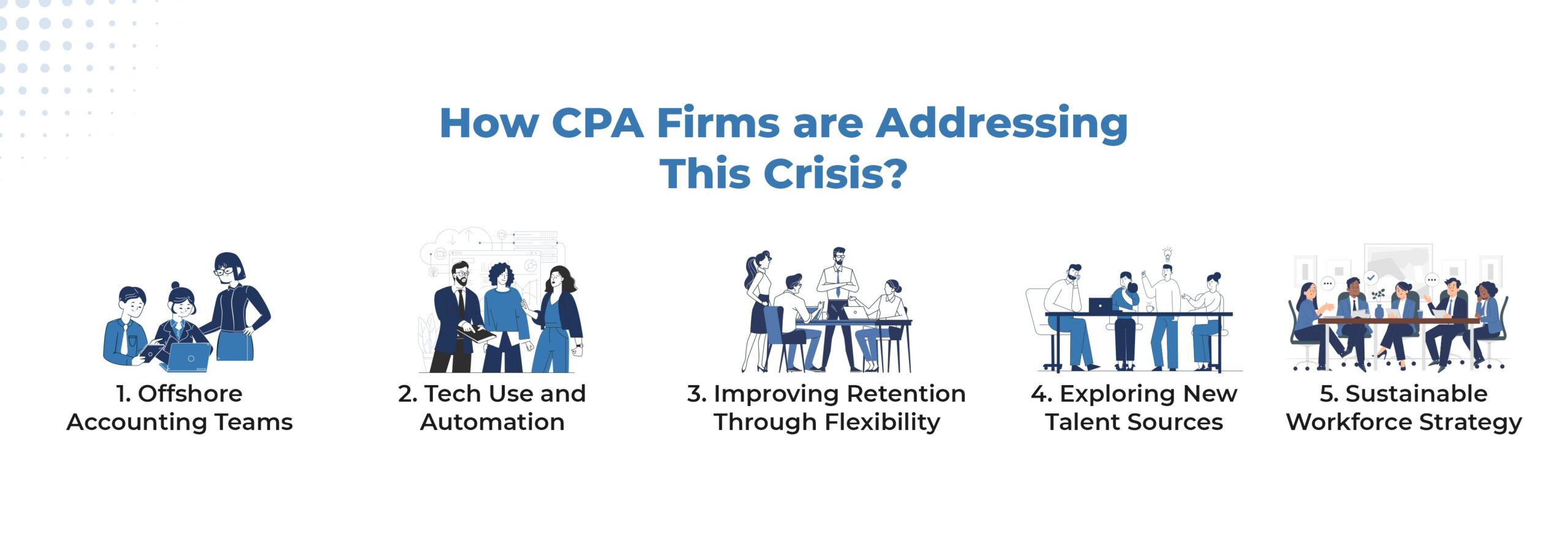
1. Offshore Accounting Teams
One of the most significant changes is the use of offshore accounting teams. This approach allows firms to access a global talent pool while maintaining high service standards. Under this model, routine production tasks are handled by trained offshore professionals.
Tasks like bookkeeping, tax preparation, bank reconciliations, payroll processing, and audit support can often be completed efficiently by offshore teams. Meanwhile, the firm’s onshore staff focus on strategic planning, advisory services, and meticulous audit reviews.
This division of labour allows firms to maintain quality while increasing capacity. For many firms, offshore teams have become a practical solution to staffing constraints, enabling them to handle growing workloads without overwhelming their internal staff.
2. Tech Use and Automation
Technology is another important part of the solution. Modern accounting software and automation tools can significantly reduce the time spent on repetitive tasks. Automation now assists with functions such as transaction categorization, bank reconciliation matching, invoice processing, and workflow tracking.
These tools help accountants process routine financial data more efficiently while maintaining accuracy. However, technology alone cannot solve the staffing shortage. While automation improves productivity, it cannot replace professional judgment or client advisory skills.
Smart CPA firms combine technology with strong operational processes and skilled professionals. By reducing the burden of routine work, automation enables accountants to focus on higher-value responsibilities.
3. Improving Retention Through Flexibility
While new hiring strategies are important, retaining existing staff is equally important. High turnover rates continue to place pressure on many firms. To address this issue, firms are increasingly introducing more flexible work environments.
Remote work options, flexible schedules, and compressed workweeks are becoming more common across the profession. These changes help firms remain competitive with other industries that already offer greater flexibility.
In addition, some firms are implementing programs such as sabbaticals, reduced-hour schedules, and career development pathways to retain experienced professionals. Retention efforts can significantly reduce the costly cycle of recruiting and replacing employees.
4. Exploring New Talent Sources
Some CPA firms are also broadening their hiring strategies to include non-traditional candidates. Instead of focusing exclusively on accounting graduates, firms are hiring finance majors or professionals from related fields and providing targeted accounting training.
Others are recruiting from smaller universities, community colleges, or career-change programs where the competition is less intense. While these hires may require additional training initially, they can help firms build a more diverse and resilient talent pipeline over time.
5. Sustainable Workforce Strategy
The CPA staffing shortage is unlikely to disappear any time soon. Structural factors such as education requirements, compensation differences, and changing career preferences will continue to influence the profession. For CPA firms, the key is to adapt rather than wait for better days.
A sustainable workforce strategy typically involves multiple approaches working together. Offshore staffing expands capacity. Automation improves efficiency while advisory services increase revenue potential.
Flexible work environments support retention. Broader recruitment strategies help build new talent pipelines. Firms that integrate these elements into their operating model are better positioned to navigate the current talent shortage while continuing to grow.
Looking Ahead
The accounting profession is entering a period of transformation. While the staffing shortage presents real challenges, it is also encouraging firms to rethink long-standing assumptions about how accounting work should be delivered.
The firms that succeed in the coming years will likely be those that embrace new staffing models like hiring offshore accounting support, invest in technology, and focus on delivering higher-value services to clients.
The silent staffing crisis is real. But for firms willing to adapt, it also presents an opportunity to build stronger, more efficient, and more resilient practices for the future.