The accounting profession is undergoing one of the most significant transformations in its history. By 2026, firms that once focused primarily on compliance and transactional services will be navigating rapid technological advancements, evolving client expectations, regulatory changes, and a persistent talent shortage.
The firms that succeed will proactively redesign how they operate, serve clients, and build teams. Below are the most important accounting trends shaping 2026, along with what forward-thinking firms should do to stay competitive.
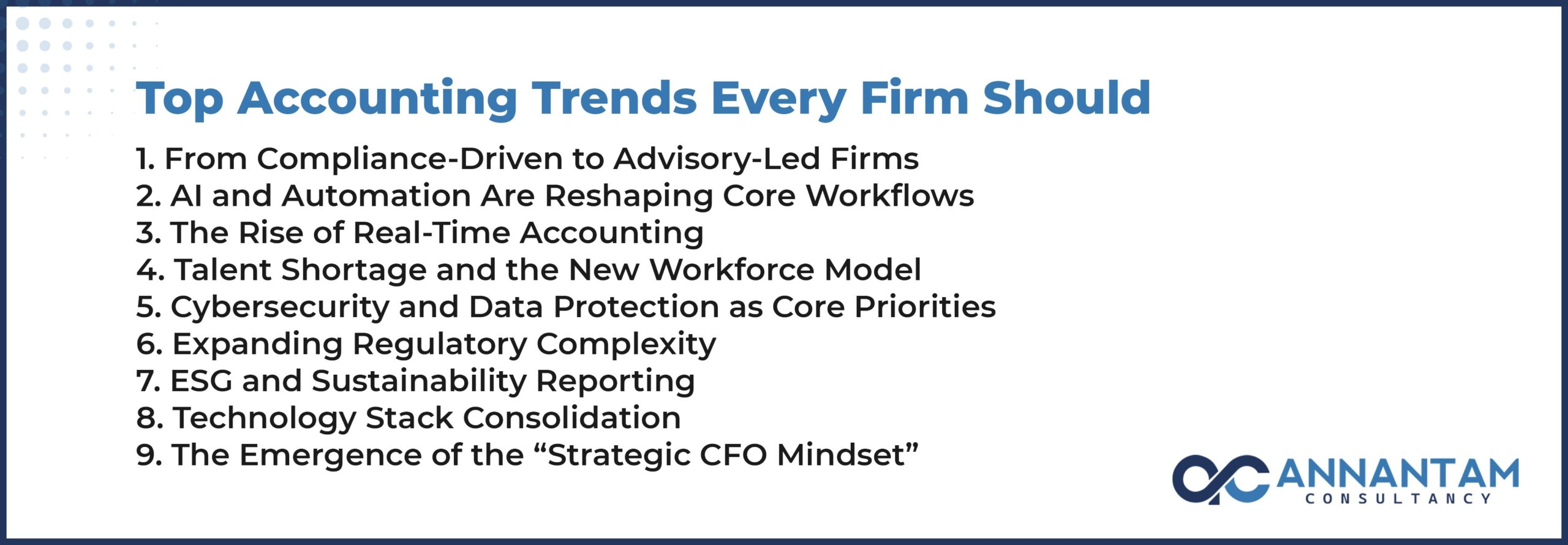
Top Accounting Trends Every Firm Should Prepare For
From Compliance-Driven to Advisory-Led Firms
Traditional accounting models centered on bookkeeping, tax filing, and financial reporting are no longer enough to drive sustainable growth. In 2026, clients expect their accountants to act as strategic partners rather than historical recordkeepers. Businesses want:
– Cash flow forecasting
– Profitability analysis
– Growth strategy support
– KPI dashboards
The shift is clear: compliance is becoming commoditized, while advisory services are becoming the primary differentiator.
What should firms do?
Invest in training teams to interpret data, not just prepare it. Develop structured advisory packages and move toward value-based pricing models.
AI and Automation Are Reshaping Core Workflows
Automation significantly reduces manual data entry, freeing professionals to focus on analysis and client advisory. However, automation does not replace accountants; it enhances them. AI is embedded in accounting software, tax platforms, and financial systems. In 2026, AI will be widely used for:
– Automated transaction categorization
– Intelligent bank reconciliations
– Invoice processing and AP automation
– Fraud detection alerts
– Predictive cash flow analysis
What should firms do?
Adopt cloud-based accounting systems with AI capabilities. Redesign internal workflows to remove redundant manual processes and upskill teams in data analytics and financial interpretation.
The Rise of Real-Time Accounting
Monthly reporting is no longer sufficient for modern businesses. The traditional 30-day close is being replaced by near-continuous accounting processes. Cloud accounting platforms now allow real-time access to financial dashboards, performance metrics, and cash flow visibility. Clients in 2026 expect:
– Instant reporting
– Real-time decision support
– Faster month-end close cycles
What should firms do?
Standardize cloud accounting stacks. Integrate accounting systems with payroll, inventory, CRM, and banking platforms to create unified financial ecosystems. Shift from retrospective reporting to proactive insights.
Talent Shortage and the New Workforce Model
The accounting industry continues to face a severe talent shortage. Fewer graduates are entering the profession, while experienced CPAs are retiring in large numbers. At the same time, employee expectations have changed. Professionals now seek:
– Flexible work environments
– Remote opportunities
– Meaningful advisory roles
What should firms do?
Adopt hybrid and remote staffing models. Consider offshore or outsourced accounting support to handle routine tasks, such as bookkeeping, payroll, and first-level tax preparation. This allows in-house teams to focus on higher-value work while reducing seasonal stress.
Cybersecurity and Data Protection as Core Priorities
With increased digitization comes increased risk. Accounting firms manage highly sensitive financial data, making them prime targets for cyberattacks. So, clients are also asking more questions about how their data is protected. In 2026, firms must prioritize:
– Multi-factor authentication
– Encrypted cloud platforms
– Secure document sharing portals
– Data backup and disaster recovery planning
What should firms do?
Develop clear cybersecurity policies. Train employees regularly on phishing awareness and data handling protocols. Work only with technology vendors that meet strong compliance standards.
Expanding Regulatory Complexity
As tax laws, financial reporting standards, ESG requirements, and cross-border compliance regulations continue to evolve, regulatory oversight is becoming more data-driven and automated, increasing the risk of penalties for inaccuracies. Key areas increasing in complexity include:
– Multi-state taxation
– Digital asset reporting
– ESG disclosures
– Increased audit scrutiny
What should firms do?
Commit to continuous professional education. Implement robust documentation systems and review processes. Leverage specialized compliance experts when necessary.
ESG and Sustainability Reporting
Environmental, Social, and Governance (ESG) reporting has moved from being optional to strategically important. Accounting firms are increasingly involved in helping clients measure, report, and validate ESG metrics because investors, lenders, and stakeholders now expect companies to disclose:
– Carbon footprint data
– Diversity metrics
– Governance structures
– Sustainability initiatives
What should firms should?
Build internal knowledge of ESG frameworks. Develop advisory services around sustainability reporting and governance practices. This emerging area offers strong long-term growth potential.
Technology Stack Consolidation
Many firms adopted multiple tools over the past few years, leading to fragmented systems and inefficiencies. But integration is now more important than simply having advanced tools. In 2026, firms are moving toward streamlined, integrated technology stacks that allow:
– Automated workflows
– Centralized dashboards
– Improved collaboration
What should firms do?
Audit your current software ecosystem. Eliminate redundant systems. Prioritize integration capability when adopting new platforms.
The Emergence of the “Strategic CFO Mindset”
Even traditional accounting firms are adopting a CFO-like approach to client service. This means focusing on:
– Long-term financial planning
– Capital allocation guidance
– Profitability optimization
– Growth strategy support
What should firms do?
Encourage professionals to think beyond numbers and develop commercial awareness. Build internal expertise in forecasting, modeling, and business analytics.
Preparing Your Firm for 2026 and Beyond
The accounting profession in 2026 is defined by transformation. Technology is accelerating, compliance is tightening, talent is scarce, and clients are demanding more value. The firms that thrive will:
– Embrace automation while strengthening human expertise
– Shift from transactional services to advisory relationships
– Invest in cybersecurity and compliance infrastructure
– Build flexible and scalable workforce models
Accounting firms that recognize the shifts and prepare accordingly will stay ahead of the curve and will lead the industry into its next era.