Economic fluctuations today demand financial clarity, which is no longer optional, but strategic. Companies that rely on disconnected accounting tools or spreadsheets often struggle with delayed reports, inaccurate forecasts, and poor cash visibility.
As financial complexity grows, so does the need for systems that unify and streamline operations. This is where integrated accounting systems make a measurable difference.
By consolidating core financial functions into a single platform, integrated accounting transforms how businesses manage budgeting, cash flow, and reporting. Instead of reacting to outdated information, organizations gain real-time visibility, predictive insights, and operational control.
Let’s explore how integrated accounting directly improves these three critical financial pillars.
Key Advantages of Integrated Accounting Systems
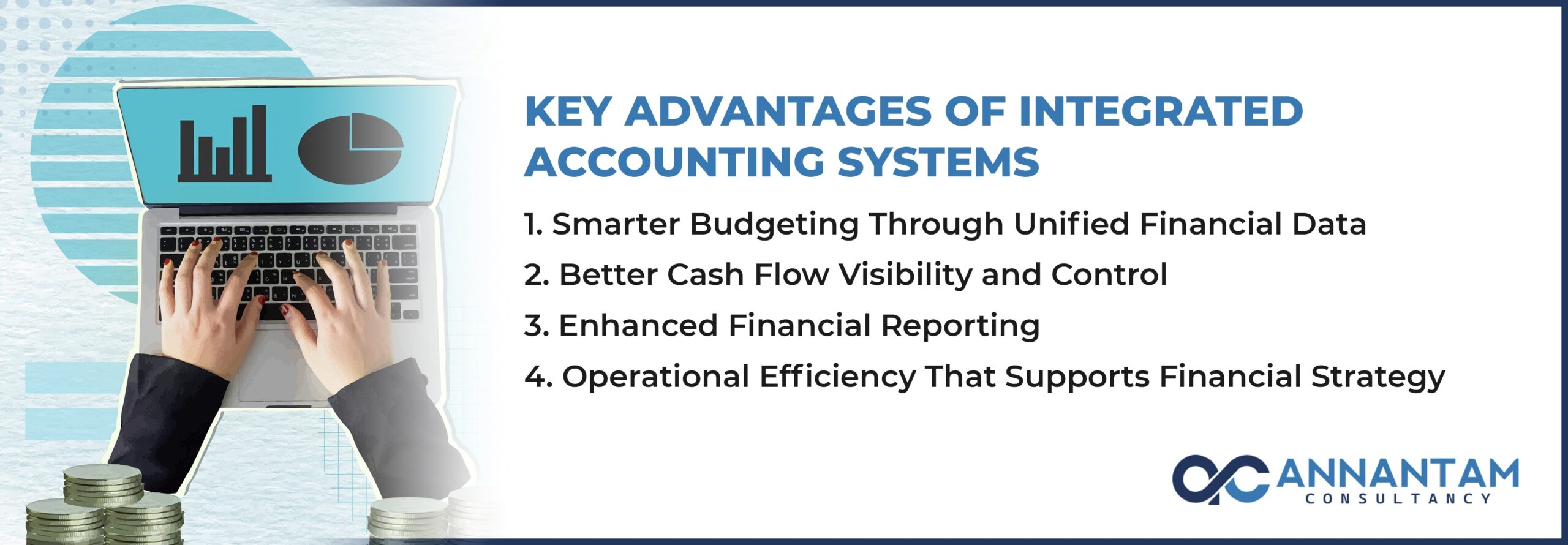
Smarter Budgeting Through Unified Financial Data
Budgeting is only as strong as the data behind it. Traditional, non-integrated systems often require manual data consolidation from multiple sources, such as sales software, payroll platforms, and bank statements. This fragmentation leads to:
- Inconsistent numbers
- Duplicate entries
- Delayed budget updates
An integrated accounting system centralizes financial data across departments. Sales, procurement, payroll, and inventory all feed into one unified general ledger. This consolidation eliminates discrepancies and provides a single source of truth.
Real-Time Budget Monitoring
With integrated systems, budgets transform from being static documents to dynamic tools that update automatically as transactions occur. Managers can compare actual performance against budget in real time, enabling faster corrective action. For example:
- Overspending in one department can be flagged instantly.
- Revenue shortfalls can be identified early.
- Cost-saving measures can be implemented before quarter-end.
Improved Forecasting and Scenario Planning
Because integrated systems maintain accurate historical data and real-time financial inputs, they enhance forecasting accuracy. This allows leadership teams to plan proactively rather than reactively. Advanced platforms use automation and analytics tools to support:
- Rolling forecasts
- Variance analysis
- Departmental performance tracking
Better Cash Flow Visibility and Control
Cash flow challenges remain one of the primary reasons businesses face financial distress. Even profitable companies can struggle if they lack visibility into inflows and outflows. Disconnected systems make cash tracking complicated.
Accounts receivable may sit in one platform, accounts payable in another, and banking data elsewhere. The result is delayed cash insights and poor liquidity management. Integrated accounting addresses this directly.
Real-Time Cash Position Tracking
With accounts payable, receivable, payroll, and bank feeds connected within one system, companies gain immediate visibility into their true cash position. Financial managers can see:
- Outstanding invoices
- Upcoming vendor payments
- Payroll obligations
- Current bank balances
This real-time view allows businesses to avoid overdrafts, negotiate payment terms, or accelerate collections when necessary.
Better Management of Payables and Receivables
Integrated systems often automate invoice generation, reminders, and reconciliation. Automated follow-ups reduce days sales outstanding (DSO) and improve cash conversion cycles. This supports better credit control and smarter cash planning.
Additionally, because customer data, sales records, and payment histories are connected, businesses can identify:
- High-risk customers
- Late payment trends
- Seasonal cash flow patterns
Predictive Cash Flow Forecasting
Modern integrated accounting platforms incorporate forecasting tools that project future liquidity based on:
- Historical payment behavior
- Budgeted expenses
- Recurring revenue patterns
This predictive insight enables proactive financial decisions such as capital investments, hiring, or expansion, all based on reliable liquidity projections.
Enhanced Financial Reporting
Accurate reporting is the backbone of financial management. However, in non-integrated environments, generating reports often requires manual reconciliation between systems, increasing both time and error risk. Integrated accounting simplifies reporting in three powerful ways.
Automated Data Consolidation
Since all financial transactions are recorded within one unified system, reports are pulled from a centralized database. This improves:
- Data consistency
- Report accuracy
- Time efficiency
Real-Time Reporting Dashboards
Integrated systems offer customizable dashboards that display key performance indicators (KPIs) such as:
- Revenue growth
- Gross margins
- Operating expenses
- Cash burn rate
Instead of waiting weeks for static reports, executives gain immediate financial insights that support strategic decisions.
Audit Readiness and Compliance
Integrated systems maintain detailed audit trails and standardized workflows. Every transaction is time-stamped and traceable, improving internal controls and regulatory compliance. This reduces the stress of audits and ensures financial statements are reliable and transparent.
Operational Efficiency That Supports Financial Strategy
Beyond budgeting, cash flow, and reporting, integrated accounting improves overall financial operations. Automation reduces manual tasks such as:
- Invoice processing
- Bank reconciliations
- Payroll calculations
- Expense categorization
By minimizing repetitive work, finance teams can shift their focus to higher-value activities like financial analysis and performance improvement. Moreover, integrated systems are scalable. As businesses grow, they can accommodate increased transaction volumes without requiring entirely new infrastructure.
Integrated vs. Non-Integrated Systems: The Strategic Difference
Non-integrated systems create silos. Silos lead to inefficiencies, miscommunication, and delayed insights. Financial decisions become reactive because data is fragmented. Integrated accounting, on the other hand:
- Centralizes financial intelligence
- Reduces human error
- Accelerates reporting cycles
- Improves forecasting accuracy
- Strengthens liquidity management
Closing Thoughts
Integrated accounting systems empower businesses to build accurate budgets, maintain strong cash flow control, and generate timely financial reports. They eliminate inefficiencies caused by disconnected systems and provide accounting teams with the insights needed to make confident, strategic decisions.
Organizations that adopt integrated accounting can gain financial agility, operational efficiency, and a stronger foundation for sustainable growth.