
Management accounting has evolved far beyond traditional reporting. Today, it sits at the intersection of finance, operations, and strategy, helping organizations move from raw numbers to meaningful insights.
Yet unlocking its full potential requires more than spreadsheets or periodic reporting. It demands strong structures, consistent definitions, automation, and intelligent systems that transform data into decision-ready information.
Below is a practical breakdown of the core elements that turn management accounting into a strategic engine.
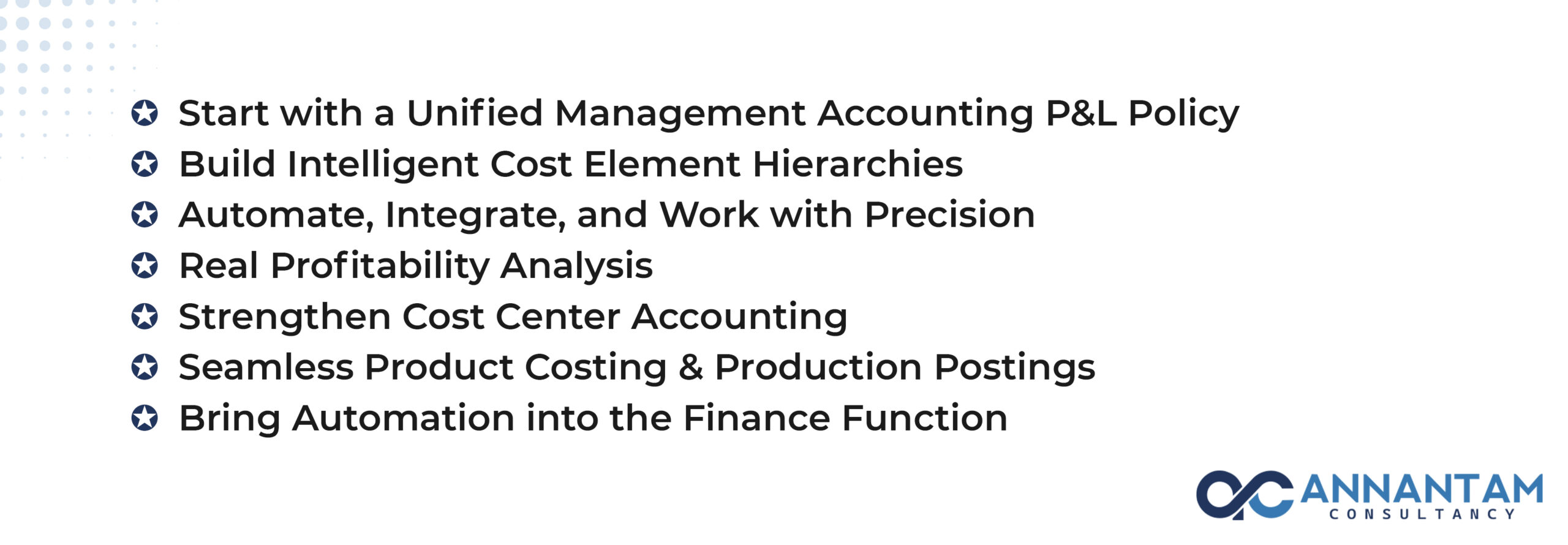
1. Start with a Unified Management Accounting P&L Policy
A globally accepted P&L policy is the foundation. Without clear definitions, financial language becomes inconsistent, and reporting becomes unreliable.
A strong P&L policy ensures:
- Uniformity across regions and business units
- Consistent line item definitions
- System-driven controls and checks
- Comparable reporting across months and geographies
This clarity sets the stage for deeper automation and governance.
2. Build Intelligent Cost Element Hierarchies
A well-designed hierarchy is the backbone of accurate cost control. Poor structure leads to misallocations, opaque overheads, and unreliable reporting. Your hierarchy should enable:
- Functional grouping of overheads
- Separation of manufacturing overheads
- Detailed cost attribution
- Clean allocation cycles
- Clear insights for variance analysis
This is where management accounting moves from fragmented data to organized intelligence.
3. Automate, Integrate, and Work with Precision
Automation is no longer a luxury. It’s essential for accuracy, speed, and scale. Automation should cover:
- Posting rules and derivations
- Integration between finance, supply chain, and commercial processes
- Workflow approvals
- Data validation rules
- Period-end close activities
The more automated your processes are, the faster you close and the fewer errors enter your system.
4. Real Profitability Analysis
True profitability isn’t just about gross revenue. Understanding what erodes that revenue and how, is where strategic insight lies. Gross-to-net analysis requires:
- Integrating revenue and discounts in Order-to-Cash flows
- Complete discount visibility (rebates, trade spend, returns, incentives)
- Accurate COGS with well-governed standard costs
- Splitting COGS into material, labor, overhead, and freight
When all these components reflect the right attributes, you get a transparent, real-time profit view.
5. Strengthen Cost Center Accounting
Cost center accounting becomes powerful when the system handles most of the complexity. Key enablers include:
- Integrated planning for activity rates
- Automated rate usage in product costing
- Accurate postings to cost objects
- Monthly actual activity rate calculations
- Manufacturing variance analysis
Good cost center accounting ensures every dollar is accounted for and every variance has a story.
6. Seamless Product Costing & Production Postings
Product costing influences pricing, profitability, and financial compliance.
This is why automation and integrated design are essential. Your system should handle:
- Standard cost calculations
- Automated production order postings
- Material consumption postings
- Activity confirmations
- Template allocations
- WIP and variance calculations
When integrated with intercompany accounting and inventory valuation, this ensures compliance with GAAP/IFRS and supports clean consolidation.
7. Bring Automation into the Finance Function
Modern ERP systems house massive datasets, perfect fuel for AI and machine learning. AI/ML unlock benefits such as:
- Detecting anomalies in real time
- Predicting cost drivers and variance trends
- Automating repetitive finance tasks
- Enhancing profitability forecasting
- Improving IoT-driven manufacturing insights
Why This Matters More Than Ever?
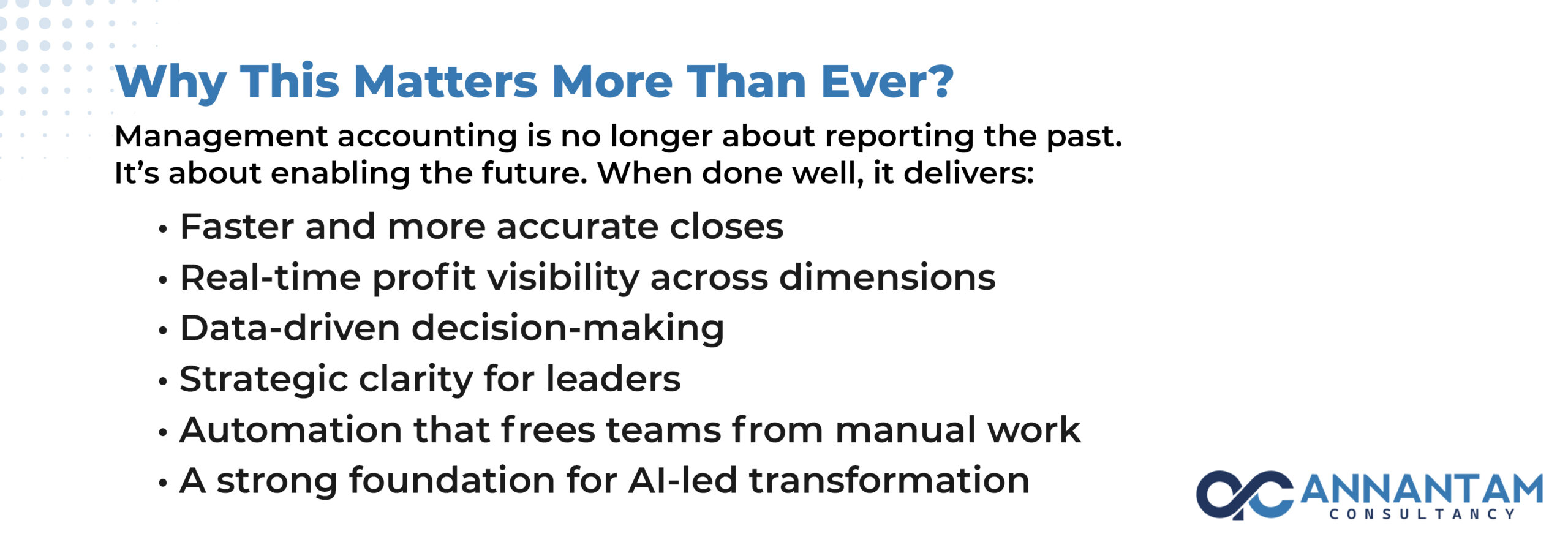
Management accounting is no longer about reporting the past. It’s about enabling the future. When done well, it delivers:
- Faster and more accurate closes
- Real-time profit visibility across dimensions
- Data-driven decision-making
- Strategic clarity for leaders
- Automation that frees teams from manual work
- A strong foundation for AI-led transformation
By designing robust policies, defining the right attributes, automating processes, and leveraging modernized tools, organizations move from backward-looking reporting to forward-looking intelligence.
Concluding Words

The real power of management accounting lies in transforming complexity into clarity. When foundations are strong and processes are automated, finance teams can shift from processing transactions to delivering strategic insights.
In a world where speed and accuracy define competitive advantage, management accounting when done right can become one of the most powerful engines of growth.
So make sure you’re leveraging the power of management accounting with the help of offshore outsourcing partners.